Kawaii Seamless Patterns: A Practical Guide to Integrating Playful Design into Professional Workflows
In the landscape of digital content creation and physical product design, visual consistency is often the difference between a amateur-looking project and a polished, professional finish. For designers, small business owners, and crafters working in the stationery, textile, or digital planning sectors, finding assets that are both aesthetically pleasing and technically robust is a constant challenge. This is where Kawaii Seamless Patterns enter the workflow. These are not merely decorative images; they are functional design assets engineered for repetition, scalability, and integration into larger surface pattern designs.
The term "kawaii" refers to a Japanese cultural concept of cuteness, characterized by soft colors, rounded shapes, and friendly aesthetics. When applied to seamless patterns, this style offers a unique value proposition: it injects joy and approachability into products without sacrificing structural integrity. Whether you are creating packaging for a children’s brand, designing pages for a digital planner, or preparing fabric prints for a print-on-demand service, understanding how to effectively utilize these patterns can streamline your production process and enhance the final user experience.
Understanding the Asset: Structure and Technical Specifications
Before integrating any graphic asset into a workflow, it is crucial to understand its technical properties. A standard image file cannot be tiled seamlessly without visible seams or awkward breaks at the edges. Kawaii seamless patterns are specifically constructed so that the right edge aligns perfectly with the left, and the top aligns with the bottom. This allows the pattern to repeat infinitely across any surface, whether it is a piece of fabric, a sheet of paper, or a website background.
The bundle described in this guide typically includes high-resolution tiles, such as those sized at 3072 × 3072 pixels. This resolution is significant for several reasons. First, it ensures that when the pattern is scaled up for large-format printing, such as wrapping paper or textile rolls, the image remains crisp and free from pixelation. Second, the JPEG format provides broad compatibility across various design software platforms, from Adobe Illustrator and Photoshop to Canva and Procreate. However, because these are raster images (pixels) rather than vector graphics (mathematical paths), users must be mindful of their intended use case regarding further editing.
Key Components of the Design
A well-executed kawaii seamless pattern bundle usually contains a variety of motifs that work cohesively together. Common elements include:
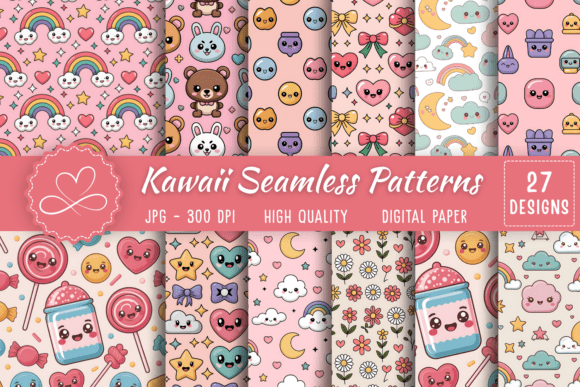
- Sweet Characters: Anthropomorphized food items, animals, or objects with expressive, simple faces.
- Pastel Elements: Soft hues like mint green, baby pink, lavender, and sky blue that reduce visual strain and create a calming effect.
- Simple Icons: Small, recognizable symbols such as stars, hearts, clouds, or geometric shapes that fill negative space.
- Cheerful Motifs: Recurring themes that tie the collection together, such as seasonal holidays or daily routines.
These components are arranged to ensure balance. In design theory, balance refers to the distribution of visual weight. A chaotic arrangement can feel overwhelming, while a too-sparse arrangement may look empty. The seamless nature of these patterns requires careful calculation during the creation phase to ensure that no single area feels heavier than another, maintaining a uniform texture across the entire repeated surface.
Integration into Creative and Business Workflows
For professionals and hobbyists alike, the utility of kawaii seamless patterns extends far beyond simply placing an image on a canvas. They serve as foundational layers in complex design projects. Here is how these assets fit into different stages of a creative workflow.
1. Preparation and Concept Development
During the initial brainstorming phase, designers often struggle with color palettes and thematic direction. Having a pre-made set of kawaii patterns can accelerate this process. Instead of starting from a blank white canvas, creators can import these tiles into their design software to test color combinations and layout densities. This is particularly useful for mood boarding. By layering different pattern tiles over one another with varying opacities, designers can quickly visualize how distinct elements interact before committing to a final composition.
2. Execution in Digital Products
Digital planners and journals have seen a surge in popularity, driven by the need for organization tools that are also visually engaging. Kawaii patterns are ideal for backgrounds in PDF planners, Notion templates, or GoodNotes pages. Because the patterns are seamless, they can be extended to fill any page size without manual cropping. For educators and bloggers, these patterns can be used to create printable worksheets or activity sheets. The playful aesthetic helps maintain student engagement, making learning materials feel less like chores and more like interactive experiences.
When implementing these patterns in digital documents, consider the contrast. Text overlaid on a busy pattern can become difficult to read. A practical tip is to place a semi-transparent white or colored shape behind text boxes to ensure legibility while still allowing the pattern to peek through, maintaining the cohesive aesthetic.
3. Physical Product Manufacturing
For entrepreneurs in the print-on-demand (POD) space, such as those selling on Etsy, Redbubble, or Amazon Merch, kawaii patterns are a high-value asset. They can be applied to a wide range of products, including t-shirts, tote bags, phone cases, and stickers. The seamless format is critical here because POD services often require specific bleed areas and repeating units. Using a tile that repeats flawlessly ensures that the design looks professional even when wrapped around curved surfaces or cut into smaller pieces.
Furthermore, these patterns are excellent for packaging design. Unboxing experiences are a key part of customer satisfaction in e-commerce. Custom wrapping paper or tissue paper featuring a cute, branded kawaii pattern adds a layer of perceived value to the product. It signals attention to detail and care, which can lead to higher customer retention and positive reviews.
Best Practices for Implementation and Quality Control
To get the most out of your Kawaii Seamless Patterns Bundle, adherence to best practices in file management and design execution is essential.
Scalability and Resolution Management
While 3072 × 3072 pixels is a high resolution, it is finite. If you attempt to scale a single tile to cover a massive billboard or a large-scale mural, you will eventually encounter quality loss. For large-scale applications, it is advisable to check if vector versions of the individual icons within the pattern are available. If not, you may need to source additional tiles or use advanced upscaling AI tools, though caution is advised to prevent artifacting. For most standard uses—such as A4 paper, fabric bolts, or digital screens—the provided resolution is sufficient.
Color Consistency Across Media
One of the biggest challenges in design is ensuring that colors look the same on screen as they do in print. Digital screens use RGB (Red, Green, Blue) light, while printers use CMYK (Cyan, Magenta, Yellow, Key/Black) ink. Pastel colors, in particular, can appear duller when converted from RGB to CMYK. Before finalizing a print run, always convert your design files to CMYK mode and perform a proof print. This step prevents surprises where vibrant pastel pinks turn out muddy or grayish in the final product.
Organizational Efficiency
With 27 distinct pattern tiles, keeping track of assets can become cumbersome. Establish a clear folder structure on your computer. Create directories based on project type (e.g., "Planner_Backgrounds," "Packaging_Designs") and subdirectories for specific color themes (e.g., "Pastel_Pink," "Mint_Green"). Naming conventions are equally important. Use descriptive names such as "Kawaii_Clouds_Pastel_Seamless_3072.jpg" rather than generic names like "image001.jpg." This practice saves time during future searches and makes collaboration with other team members smoother.
Expanding Creativity Through Modification
Although the patterns are provided as JPEGs, they offer flexibility. Even without vector editing capabilities, designers can manipulate these tiles to create new variations. Techniques include:
- Recoloring: Using adjustment layers in Photoshop or GIMP to shift hues, saturation, and brightness. This allows you to adapt a spring-themed pattern for a winter collection by cooling down the tones.
- Layering: Combining two different seamless patterns by placing one above the other with a blend mode (such as Multiply or Overlay). This creates complex, textured backgrounds that feel unique and custom-made.
- Cropping and Tiling: You can crop a section of a larger pattern to create a smaller, denser motif, or zoom out to reveal more negative space, changing the rhythm of the design.
These modifications allow you to tailor the assets to specific brand guidelines without needing to commission new artwork from scratch. This efficiency is invaluable for freelancers and small business owners who need to produce content rapidly.
Long-Term Value and Strategic Use
Investing in a comprehensive bundle of Kawaii Seamless Patterns is not just a one-time purchase; it is an asset accumulation. As your portfolio grows, these patterns become reusable resources. A pattern created for a summer planner might be repurposed for a beach-themed invitation suite or a children’s party decoration line. The versatility of the kawaii aesthetic means it transcends age groups and industries, appealing to both children and adults who appreciate nostalgic, comforting visuals.
Moreover, in an era where personalization is key, having access to a library of cute, colorful patterns allows you to offer customized options to clients. For example, a wedding planner might request a subtle, pastel pattern for their event branding. With a diverse collection, you can meet such requests quickly, enhancing your service offering and competitive edge.
Conclusion
Kawaii Seamless Patterns represent a powerful tool in the modern designer’s arsenal. They bridge the gap between artistic expression and technical precision, offering a way to bring warmth and charm to functional objects. By understanding their technical specifications, integrating them thoughtfully into workflows, and adhering to best practices for quality control, creators can leverage these assets to produce high-quality, engaging products. Whether you are designing digital goods, physical merchandise, or educational materials, these patterns provide a reliable foundation for building brands that connect emotionally with their audience. Embrace the playful potential of these designs, and let them add a touch of joy and professionalism to your next project.